

The Problem With Judging Meta by ROAS Alone
ROAS is attractive because it feels definitive. It gives you a clean ratio and a quick answer. Spend this much. Make that much. Done.
But ecommerce growth is rarely that simple.
Meta is not just a direct response channel. It is a discovery engine. It introduces new customers to your brand long before they are ready to purchase. It reinforces credibility. It builds memory structures. It shortens future buying cycles. And most importantly, it feeds every other layer of your marketing ecosystem.
When we evaluate Meta purely by ROAS, we are only measuring the transactions that happened within a specific attribution window. We are not measuring the influence Meta had on purchases that closed through email, organic search, direct traffic, or even in store. We are not measuring how many new buyers entered the ecosystem. We are not measuring future demand.
ROAS tells you what converted immediately. It does not tell you what was created.
Key takeaway
- ROAS measures direct return, not influence
- Meta drives discovery, not just conversions
- Immediate revenue does not equal total impact

A Refresher, What Is ROAS?
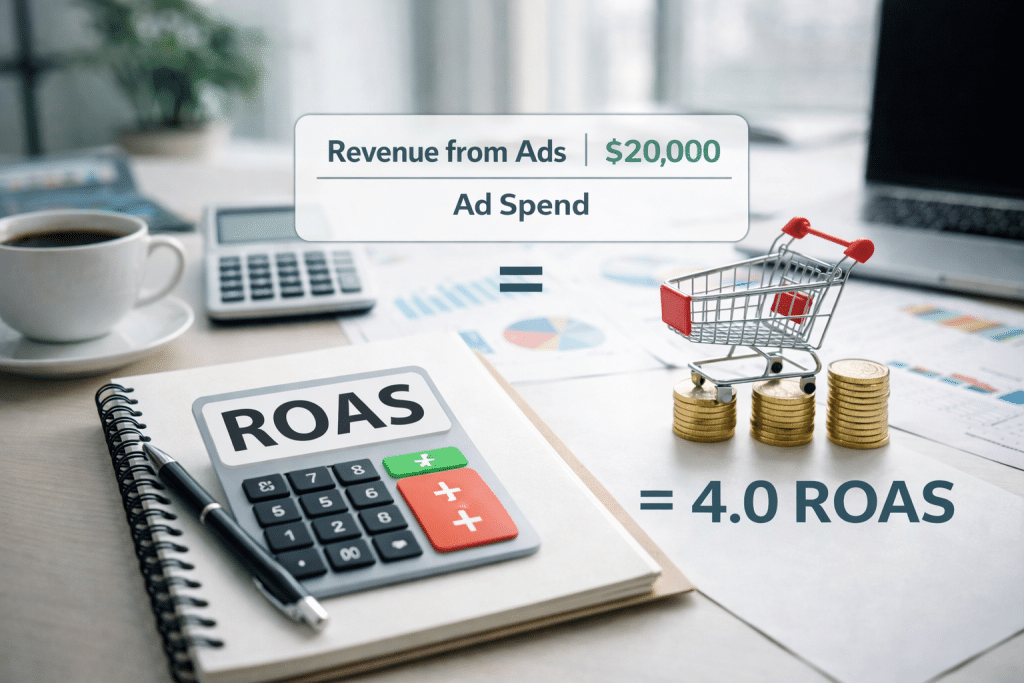
ROAS stands for Return on Ad Spend. It measures how much revenue is generated for every dollar spent on advertising.
ROAS = Revenue from Ads ÷ Ad Spend
For example, if you spend $5,000 and generate $20,000 in tracked revenue:
20,000 ÷ 5,000 = 4.0 ROAS
This means you earned four dollars for every one dollar spent.
ROAS shows short term efficiency based on attributed revenue. It does not reflect assisted conversions, long term brand impact, or customer lifetime value.
Ecommerce Growth Happens in Layers, Not in a Single Campaign
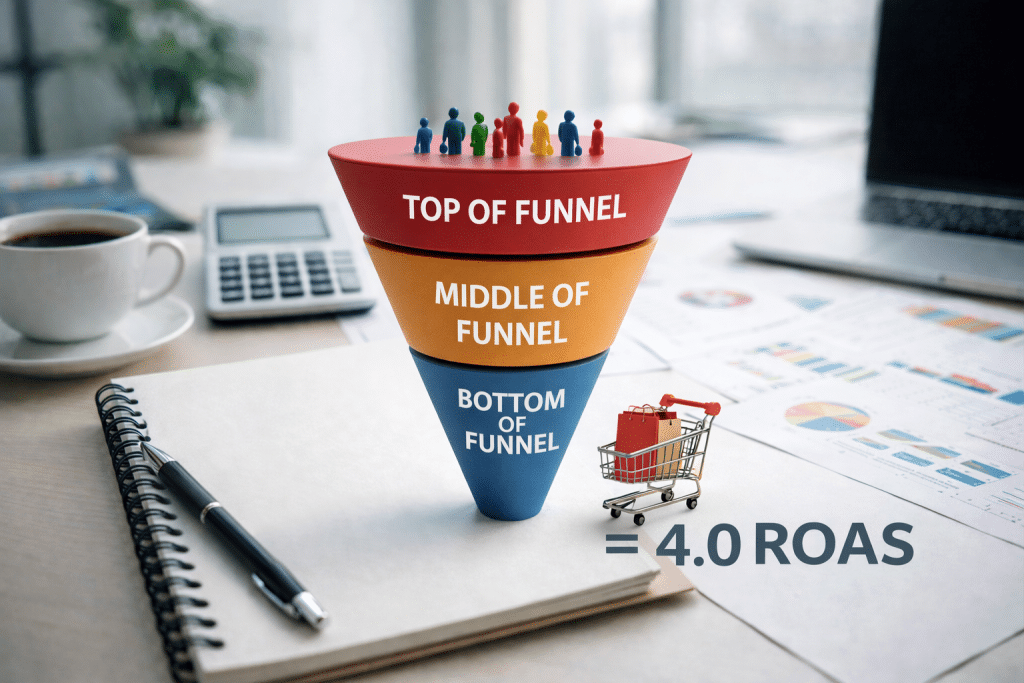
A healthy ecommerce account is structured around a sales funnel. Each layer has a distinct job. If you collapse everything into one conversion campaign and judge it only by ROAS, you remove the strategic structure that enables scale.
Top of Funnel: Creating Demand
Top of Funnel campaigns introduce your brand to cold audiences. These are people who do not know you yet. They are not searching for you. They are not comparing you. They are simply scrolling.
At this stage, the objective is not immediate conversion. It is attention, engagement, and audience building. Video views, traffic, content interaction, and new customer acquisition all matter here.
ROAS at this stage often looks low. That is not a flaw. It reflects the reality that most cold users do not convert on first exposure. The goal is to seed future demand and build retargeting pools.
If you shut off TOF because it “is not profitable,” you eventually starve your BOF campaigns of fresh prospects.
TOF summary
- Introduces new audiences
- Builds retargeting pools
- Expands future demand
- Typically produces lower immediate ROAS
Middle of Funnel: Warming the Audience
Middle of Funnel campaigns speak to people who have already interacted with your brand. They may have watched a video, visited your website, engaged with your social content, or added a product to cart without purchasing.
This stage builds familiarity. It reinforces positioning. It answers objections. It increases perceived trust.
The impact of MOF campaigns is rarely isolated inside a single ad set. Their value appears in improved conversion rates later, higher returning customer rates, and stronger BOF performance.
Judging MOF by standalone ROAS often leads to underinvestment in the very campaigns that increase overall efficiency.
MOF summary
- Nurtures engaged audiences
- Reinforces brand positioning
- Improves downstream conversion rates
- Strengthens overall account efficiency

Bottom of Funnel: Converting Intent
Bottom of Funnel campaigns target high intent users. These audiences include product viewers, add to cart users, initiated checkouts, and past purchasers.
This is where ROAS often looks strongest. But BOF does not exist in isolation. Its performance is directly dependent on how well TOF and MOF are feeding it.
If you over optimize for BOF ROAS, you can create the illusion of profitability while quietly shrinking your pipeline. Retargeting audiences get smaller. Frequency increases. Efficiency drops over time.
High BOF ROAS without healthy TOF and MOF activity is not sustainable growth. It is demand harvesting.
BOF summary
- Targets high intent users
- Typically shows strongest ROAS
- Depends on upstream funnel health
- Cannot scale without prospecting

Meta Influences More Than It Directly Attributes
Consumer journeys are fragmented. A typical path might look like this:
- Someone sees your Meta ad.
- They scroll past it.
- They visit later through Google.
- They join your email list.
- They purchase from a campaign email two weeks later.
- ROAS will not fully credit Meta for that sale.
Meta also influences branded search lift, direct traffic, repeat purchase behavior, and even conversion rates inside other channels. These halo effects rarely appear in a single ad manager dashboard.
If you focus only on in platform ROAS, you undervalue assisted conversions and long term brand building.
Attribution reality
- Buyers rarely convert on first click
- Meta assists other channels
- ROAS does not capture cross channel impact
- Brand lift drives long term revenue

What Should You Measure Instead?
ROAS is still useful. It simply needs context.
Instead of relying on it as the primary success metric, consider looking at:
- Blended metrics across all channels.
- New customer acquisition growth.
- Cost per new customer.
- Lifetime value.
- Expansion of retargeting audiences.
- Overall revenue trends.
- Marketing efficiency ratio.
When TOF, MOF, and BOF are aligned, you will often see:
- Improved conversion rates.
- Higher average order values.
- Stronger returning customer percentages.
- More stable revenue month over month.
Those signals reflect system health. ROAS reflects a single campaign snapshot.
Better indicators of success
- Blended revenue performance
- New customer growth
- Customer lifetime value
- Funnel expansion and audience growth
- Long term revenue stability
Final Thought - The Bottom Line
Meta is not simply a conversion engine. It is a growth lever.
If you judge it exclusively by ROAS, you will over invest in retargeting and under invest in demand generation. Growth will eventually plateau, even if reported ROAS looks strong in the short term.
A balanced Meta strategy builds awareness at TOF, nurtures trust at MOF, and captures demand at BOF. Each layer contributes differently to revenue. Each layer deserves measurement aligned with its purpose.
ROAS is one metric. It is not the strategy.